« September 2007 | Main | November 2007 »

31/10/2007

Face Off for FaceBook

Well well well.... I guess we all knew Google wouldn't take kindly to the rise of Facebook, the young whippersnapper. One of the really cool things about Facebook was its open source policy, letting outside techies develop applications that Facebook users could download and share on the site - enabling real collaborative creativity and in the process contributing to its success.

Not to be outdone or out manoeuvred, 'an alliance of companies led by Google is planning to introduce a set of common standards that will let software developers write programs for Google's social network, Orkut (huge in Brazil), and others such as LinkedIn and Friendster.'

'A cross-site, open platform will, Google hopes, be more attractive to developers than Facebook, and siphon off some of the momentum from the rapidly growing site, for which more than 5,000 applications have been written since it opened its platform in May.'

So widgets (as these open applications are known) will become more and more integral to websites development and offerings. Their potential is as yet unclear but certainly huge.

Have a look at the full article from The Times

Search Engine Marketing - Google Ad Revenue

Google is poised to outstrip the quarterly revenues of the UK's leading commercial TV channel, ITV1. The search giant recorded a total of $661m (£320m) in revenues from the UK between July and September.

See the full story on the Guardian

They own over 80% of the UK search market, the vast majority of journeys online start with search, search is also been proven to be essential to the job hunting process, it is also normally the most cost effective media (i say normally as you have to manage it).

So why why why are clients still not investing enough cash in search, why are the search propositions of most agencies lean and why do people still waste money doing new things when they are still not doing the basics?

New is fun but search actually works

29/10/2007

Google Earth + Second Life = Wet Dream?

We've been pretty excited about this for a while, but the post 'a Social Network for Google Earth?' on the Google Operating System blog really put some more meat on the bone

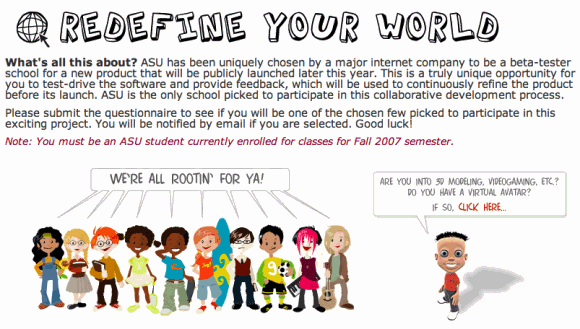
Basically the strong rumour is that Google is about to launch a Second Life-type metaverse or virtual world where users create their avatars and are then able to build, trade, engage in a virtual Google Earth.

As Anthony Mayfield hints at in his blog Open, this sounds to me like a brand manager's wet dream: the targeting ability of Google AdWords overlaid onto Second Life with the photo-realstic qualities of Google Earth.... So if someone pops into a virtual t-shirt store, you can target them ( in their language, in their time ) with a talking avatar for the same in the real world.

This is the Intro page shown to Arizona State Uni students who are apparently trailing this new world. All that remains now is for someone to launch the world's first virtual recruitment event ;-)

Carve Consulting: Google Earth meets Second Life

Oh Happy Day! Universal Search and why content is king once more

Have you heard about Universal Search yet? Well if you haven’t, you will soon.

Universal Search, as the name suggests, is Google’s response to the huge volume of different content now searchable online – web pages of course, but also podcasts, reference book pages, videos, forum posts, images, blog posts, RSS feeds and so on.

In a post entitled “The Best Answer is Still the Best Answer” Marissa Mayer, VP Search Products & User Experience, sets out the vision:

With universal search, we're attempting to break down the walls that traditionally separated our various search properties and integrate the vast amounts of information available into one simple set of search results.

Basically, this is good news for users (why search under different tabs for images, blogs, videos about Steve Jobs when you can now get all the results on one page) and good news for website owners who care about creating an engaging web experience because sites with regularly updated content ( blogs, podcasts, vodcasts etc ) are going to be better ranked than their non-dynamic counterparts.

Of course, there is also new challenges for brands and their agencies. This belief-defying, cringe-inducing Ernst & Young Recruitment Days video on YouTube is, thanks to Universal Search,  the fifth highest result on a Google search for ‘Ernst and Young’ .

Not a “Happy Day” for E&Y coporate comms, and another great example of why HR and PR need to carefully monitor social media and listen to the conversation

Enjoy the below, but do check out the post on YouTube as the comments illustrate the risk to brands of collaborative media.

What makes an award winner?

This is a question I ask myself on occasions.

And you know, it’s not because I’m bitter, or that I really don’t know, it’s more that I just don’t understand the judging process sometimes.

I know this has been debated on this blog before, and I’m probably going to generate a string of negative comments, but I think it’s worth it just to stimulate a discussion on this subject.

Take the recent NORA awards.

MidlandsIn this were at least five websites – The Royal Navy, West Midlands Police, Tesco, S3 Group and the National Health Service. The one for me that stood out here would be the Royal Navy site – a site rich with information, interactivity and just ‘stuff’ that absolutely held your interest. No doubt, a no-expense-spared exercise, but one that truly engages the visitor – be they either that casual browser, or an active job seeker.

Interestingly, the winner was The West Midlands Police force site – a relatively simple, and quite disarming site that seems quite happy to poke a little fun at itself. It doesn’t seem to take itself too seriously (Plodcasts, for example), and that’s a refreshing change.

But, was it a winner in this company? Possibly not, in my opinion. But then again, who cares about my opinion… Not many of you I suspect.

The thing is, what I’d like to see here alongside this winner is ‘why’ the judging panel chose this particular site? What was it that stood out?

For me, what stands out (unfortunately) are the in-page scroll bars – both vertical and horizontal – that are a big usability no no?  Then there is the top nav that actually, when you click on it, doesn’t always (sometimes it does, sometimes it doesn’t) take you to an actual page of content, but just brings up a sub-navigation – a fact that took me a little while to realise.

Perhaps it was the fact that it appeared to contain several ‘buzz-word’ features that, when you look into them, aren’t really what they say they are.

You know, there is a lot that’s not bad with this site, but I just don’t get it. How can it be the winner?

For me, an award winner should be a site that shows a cohesive, consistent user experience, engaging the visitor, prompting them if their action is going to result in something unusual occurring (the audio file that opens in a pop up when you click on ‘Police Officers’, for example), adds value to the visitor experience, and presents the recruiting organisation in a way that completely engages the user.

WMP goes some way towards this, but I just don’t think it was the best in this field.  Sorry.

It’s happening again, I’m coming across all negative, and I’m sorry about that. I'm not always negative, I just want to understand why someone has been given an award - that's all. The WMP have certainly given it a go, and all credit to them - they have created something quite fun, quite disarming, and pretty personal, but I just don’t know if it is the best of the ones that were involved in the shortlist.
26/10/2007

The email is dead! Long live the wiki!

Ever feel like you are suffering from information overload? That your email inbox is creaking under the weight of inappropriate emails asking whoever borrowed the big presentation folder to please return it to the second floor. Or how about that flashing red light of your blackberry? Who would have thought that a small flashy red light would have so much control over us? ‘…Light is flashing must check it now!,… the light is my master….’

-

I came across this article on my hometown newspaper website, The Belfast Telegraph a while back now and found it really interesting in terms of just how fast methods of communications are at changing and evolving. The full article can be seen in the link above, but to summarise, it centres around an incident with a top executive at the investment bank Dresdner Kleinwort who at receiving 250 emails a day had a fit of Crackberry rage and smashed the handset on his kitchen worktop. When his bosses found out about the incident rather than issue him with a reprimand they actually set about an initiative to find a system that would limit the use of actual emailing within the entire company. Their belief was centred on the premise that too much information harms productivity and that email is controlling us rather than the other way round.

-

The alternative that these guys came up with was a type of wiki (Socialtext) which:

‘Much like Wikipedia, Socialtext allows people to set up pages for specific projects, and invite anyone to collaborate: edit text, add comments, hold discussions, and link to other documents, graphics or internet sites. In short, it removed the need to send e-mails – something that everyone at Dresdner Kleinwort agreed had only caused confusion, with all the endless conversational threads and differing versions of documents.’

Use of emailing at the company has dropped significantly.

-

We recently won a global client who works using a wiki system and it does faciliate better sharing of information, a clearer understanding of where we are at with our projects and instills a real sense of collaboration between all parties involved.

-

The article goes on to touch on the benefits of Google applications like Goggle Docs which enable a community of people to contribute to and edit the same document. The use of wiki’s and applications like Google Docs are more examples of the ‘open source’ culture the digital age is facilitating – people (especially in a global business context) can have dialogue with each in a more productive, collaborative and efficient way like never before.

-

The World really is Flatter.

25/10/2007

Google & Nielsen link up for better view of TV ad watchers

I am going to have to stop drinking strong coffee … it starts me off on a rant. But I am not sure if anyone has seen the link up between Google and Nielsen to improve the accountability of TV advertising IHT.

There is a wonderful quote saying that Google executives are fearless and don’t mind who they upset … well … . I remember when I first moved into recruitment from consumer advertising I was shocked. The first thing I sold was a banner – to a rather large agency and I got into a conversation with the planner. They wanted to buy based on time – I wanted to sell on time and page impressions.

Not matter how much I tried to tell them that my method was more robust – they could not get their head around page impressions. In the end I sold on time and PI and they purchased on time. A good compromise but I was really not very happy – why? Well it felt like I was stepping back to the dark ages.

Why are we still buying using time? Well it is because we don’t have the time, the business process is not set up for performance models and we are trying to fit old business models to new mediums.

When buying in Newspaper, magazines etc … we were purchasing advertising in mediums whose primary aim was informing their readers. The main purpose was not and is still not to get people jobs.

Job boards are different … the objectives of the consumers and advertisers are very similar. A job board is a bit of software that sits between the two parties to make searching quicker and to open up the market. So there is a natural collaborative model – like PPC on Google.

The job boards, a number of clients and a few agencies have really pushed to improve accountability. But the vast majority of clients and people in the process still do not use this information. Until they do we will not be able to move towards performance models.

And believe me an optimized performance model always outperforms a time based purchase when you are driving response (both volume and quality). As a side note branding has different objectives and thus needs performance models that track these objectives (but the same principle of control is needed).

Why have we not changed? Well fear plays a big part and this industry has been under such pressure over the last few years – the well-oiled print processes now need to move to well-oiled digital processes.

The main difference between the two is the important of control and maintainance of digital campaigns. Going live is the starting point not the end, as is it with press advertising, to put it into the historical context – vouching is now done using media owner and third party ad-serving. Is it time for some of the media to start moving towards these new models? I feel that one or two will help to push the agency model.

The current growth rates in recruitment classified online is actually holding back the real opportunity. With huge increases in spend – why change our model?

Well because the more accountability we bring in, the more informed media decisions we make and the more time we focus on optimizing will really help to get us on track. That means better quality hires and more profitability all around. Clients, media and agencies all really have a vested interest in the change.

23/10/2007

Strange Games and Funky Things

Nope, I am not chatting about the Masters At Work CD, but about all the current interest in games. All areas are currently interesting.

Advertising in-game or on gaming-sites – you have seen GCHQ, US Army and Royal Navy all currently using and getting a lot of press around the activity. The Royal Navy creative is especially good and you can see it on the link above. This is a traditional advertising approach applied to a new medium and probably the most effective at this moment in time.

Bespoke games to help the recruitment process – the US Army is the most high profile of these but the RAF & Navy also have good applications. Always great for a brand if you can get people to engage with your communications but there are ethical issues.

Also using games to provide feedback on peoples problem-solving and performance skills – apparently Google have a patent. There are issues on how applicable this is to job performance due to the ‘role-playing’ when using games.

My gut feeling is that we will start to see greater usage of all three applications over the next few years – I have even said this in public (so I must believe it). I also feel there are a few new applications that we will start to see developing in the online testing area – using gaming programming techniques to provide experience and feedback for candidates.

This is a trend that will combine with more powerful search algorithms and improved communication technology to really start to change recruitment communication.

But this growth in sensory mediums does keep raising a question at the back of my mind – do we (the industry) have the skills to drive this change?

The reason I ask this is something Dave Smith at Career Builder said earlier this year that we are all talking about web 2.0 but we are still not using job postings and search particularly well.

We are all looking to the future, which is great. But are we developing the skills to deliver truly integrated recruitment communications now?

I am really interested to see what people think?

22/10/2007

Interesting Use Of Mobile Mkt For Recruitment

I was looking around today and found this http://www.gluelondon.com/casestudy/RoyalNavy_GetTheMessage.pdf

It is a very interesting application of mobile marketing ... plus a recruitment campaign winning awards (wow)

I just thought you would all find it interesting.

18/10/2007

The Internet

Not sure what else i can say - THIS CHANGED MY LIFE